


Exploring the Pink City: My Jaipur Itinerary & Must-See Attractions
Updated: Dec 13, 2025
"The echoes of the lost history,
the enigma of magnificent fortresses,
rises against the amber-washed sky;
the hush of the unheard footsteps,
guards the secret tales, kept close by..."

In October, when autumn had just set in, when the leaves had found their way to rebirth, I visited Jaipur and had the pleasure of exploring its rich culture, vibrant food scene, royal architecture, and timeless history. During my Jaipur trip, I had the chance to wander through the dreamy Pink City and document its must-see attractions in my travel diary. In this blog, I’ll share my personal experiences, anecdotes, the Jaipur itinerary I followed, the best places to visit in Jaipur, and some practical travel tips for first-time visitors.
How My Journey to the Pink City Began:
Jaipur had always been on my mind, waiting patiently for the doorway to open into an authentic travel experience. Feeling a bit fatigued from my daily routine, I decided to book a flight two weeks earlier — a small choice that felt like a gift to myself. As the plane descended over the Pink City, I could see evening lights weaving the city into a secret story, like a sky full of fireflies. I felt a sense of calm settling in, my mind loosening into a thread ready to entangle into an unknown yet enlivening experience this Jaipur trip would lead to.

How I Planned My Jaipur Trip:
As I mentioned earlier, I had planned my trip only two weeks before the travel date. With my daughter on vacation, the three of us, including my husband, escaped into the Pink City, ready to explore its royal palaces, bustling streets, and hidden gems. This short-notice journey turned into an unforgettable experience, giving us a chance to discover Jaipur's culture, history, and vibrant life.

Best time to visit Jaipur:
The best time to visit Jaipur is during the winter months, from October to March, when the weather is pleasantly cool and perfect for wandering through forts, palaces, and bustling markets. December to February is the peak tourist season, with the city buzzing with life and colours. The scorching summers, from April to June, are best avoided if you’re not a fan of intense heat, and the monsoon months, July to September, bring occasional heavy rains.
During our Jaipur trip, the afternoons were quite hot, especially while exploring the forts and streets, but the evenings were pleasantly cool, perfect for strolling through the Pink City and enjoying the vibrant markets. The contrast of the intense daytime sun and the gentle evening breeze made each day feel like a true Jaipur experience.

Must-See Attractions in Jaipur (The Places That Made My Trip Special)
During our Jaipur trip, I planned a mix of sightseeing, food experiences, and leisure, so that each day felt full but not rushed. We spent our time exploring the Pink City—from majestic forts to vibrant bazaars, City Palace to Hawa Mahal, Amer Fort to Chokhi Dhani —thereby making a fulfilling, unforgettable experience to bring home. Here’s how we spent three unforgettable days discovering the city’s must-see attractions.
Hawa Mahal – The Iconic Face of Jaipur:
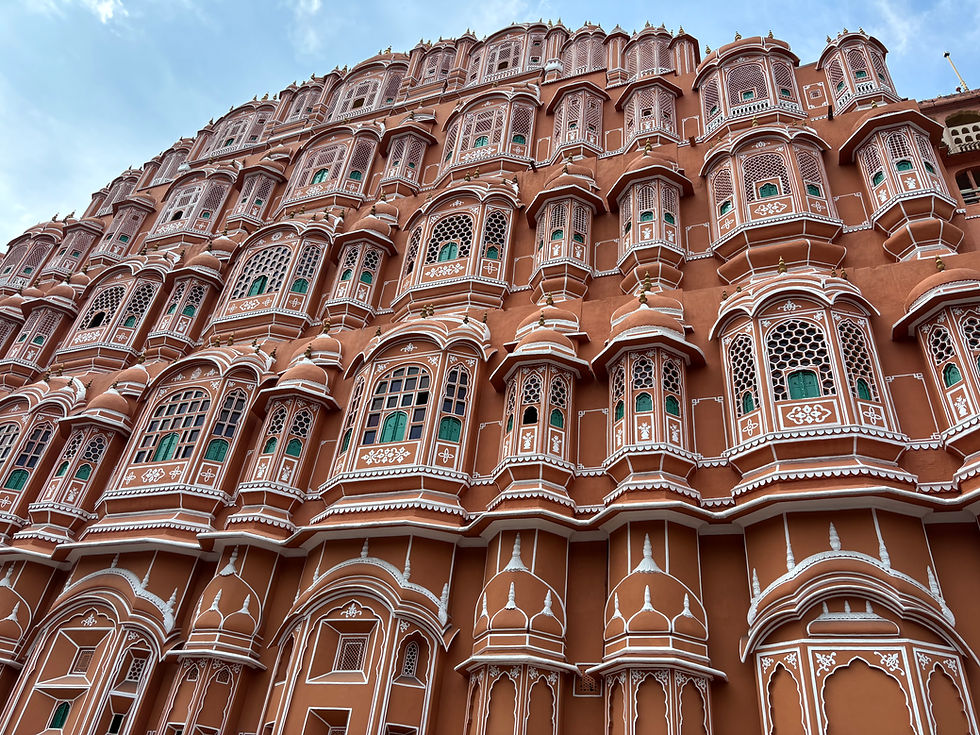
Some places don’t simply stand tall — they breathe, whisper, and watch over the centuries. Hawa Mahal in Jaipur, the iconic Palace of Winds, felt exactly like that the moment I saw it. A quiet guardian of Rajasthan’s royal past, yet shimmering proudly in its pink splendour, it remains one of the most mesmerizing heritage sites in Jaipur.
We began our first day in Jaipur with this breathtaking marvel, and honestly, I couldn’t have asked for a more magical beginning. It felt like the city was gently opening its doors, inviting us in with stories carved in pink sandstone and winds that carry centuries of untold tales.
The front section of Hawa Mahal was incredibly crowded, not just with excited tourists but also with photographers vying for the perfect shot. For a moment, it felt almost impossible to capture a peaceful picture of the iconic Palace of Winds. Somehow, after waiting and manoeuvring through the lively chaos, we managed to snap a few photos and finally make our way inside this breathtaking landmark in Jaipur.
Built in 1799 by Maharaja Sawai Pratap Singh and imagined by the gifted Lal Chand Ustad, this architectural wonder was more than just a royal creation. It was a sanctuary, a place where royal women, bound by the purdah system, could gaze upon the city’s vibrant streets without ever being seen. Its 953 latticed windows, those delicate jharokhas, weren’t just ornamental marvels; they were tiny portals connecting hidden royal lives to the bustling world outside. And in the fierce Rajasthani summers, these honeycombed jharokhas became a natural cooling system, allowing gentle breezes to flow through the palace, the very reason it earned the name Palace of Winds.
As I stood before its five-storey façade, the intricate design shimmered in the morning light, almost as if the palace itself was alive, inhaling and exhaling with the city. The pyramidal crown rising above resembled the divine crown of Lord Krishna, adding a spiritual grace that travellers often feel the moment they look up. Perhaps that’s why Hawa Mahal feels less like stone and more like a living memory, something cherished, protected, and deeply loved.
Often described as the jewel of Jaipur tourism, this masterpiece is a perfect conversation between Rajput strength and Mughal elegance, a fusion so seamless that it feels like two cultures holding hands across time. Its pink façade isn’t just beautiful, it defines the very identity of Jaipur, the famed Pink City.
Inside Jaipur’s City Palace:

After stepping out of the windswept beauty of Hawa Mahal, our next destination was the magnificent City Palace of Jaipur: a place that doesn’t just stand as a structure, but unfolds like a living chapter of Rajasthan’s royal history.
Located deep within the old walled city, the City Palace was conceived and built by Maharaja Sawai Jai Singh II, the visionary founder of Jaipur. From the moment we walked through its grand gateways, the palace felt like a serene world of its own — a graceful fusion of Rajput and Mughal architecture, wrapped in soft pink hues that define the very spirit of the Pink City.
What makes the City Palace truly remarkable is that it’s not just a museum or a monument. It is still home to Jaipur’s ruling royal family, who reside in a private section of the palace. There is something quietly humbling about walking through hallways where history was lived, not just written.
The sprawling complex houses two of its most famous structures: Mubarak Mahal and Maharani’s Palace. Mubarak Mahal, once the palace of reception, now hosts the Maharaja Sawai Man Singh II Museum, an exquisite collection of royal costumes, shimmering Pashmina shawls, elegant Banaras silk saris, Sanganeri-printed garments, delicate folk embroidery, and even the enormous clothes of Maharaja Sawai Madho Singh I. Each piece feels like a window into the personal life of the royals.

The Maharani’s Palace, on the other hand, surprised me with its stunning display of Rajput weaponry — swords, shields, and arms dating back as early as the 15th century. The ceiling paintings here are beautifully preserved, glowing softly under the light as if time has barely touched them.
Walking through the courtyards and intricately carved gateways, it is impossible not to imagine the grandeur of the Kachwaha Dynasty, one of India’s most powerful royal families. Their reign stretched nearly a thousand years, and their legacy is visible in every fortress, temple, and palace they built, but the City Palace remains their most dazzling creation.
As we explored its courtyards, we realized why the City Palace remains one of Jaipur’s most iconic tourist attractions. It isn’t just about opulence or design. It is about stories whispered through pink walls, embroidered into royal costumes, and echoed in the rustle of old silk. And walking through it felt like stepping into the heartbeat of Jaipur itself.
For travellers, reaching the City Palace is easy — autos, taxis, and local buses all connect directly to this landmark in the heart of Jaipur.
Jantar Mantar Observatory:

After a relaxed lunch at Baradari Restaurant inside the City Palace, we made our way to Jantar Mantar, one of Jaipur’s most extraordinary treasures. Built in 1734 by Maharaja Sawai Jai Singh II, this UNESCO World Heritage Site stands as a stunning reminder of India’s astronomical brilliance.
Jantar Mantar showcases nineteen remarkable stone instruments, including the world’s largest stone sundial — each designed to track celestial movements, measure local time, and observe astronomical positions with the naked eye. Though it no longer functions as an active observatory, it remains a beautifully preserved monument where tours and educational sessions bring its history to life.
The very name “Jantar Mantar,” derived from the Sanskrit yantra (instrument) and mantrana (calculation), perfectly reflects the purpose behind these awe-inspiring structures. Restored multiple times and protected as a National Monument, it stands today as one of the world’s finest architectural and scientific wonders, drawing travellers, astronomers, architects, and curious souls from across the globe.
Patrika Gate:

We made an unplanned, quick visit to the Patrika Gate in Jaipur, and it turned out to be a delightful surprise. Having mostly seen videos of this stunning landmark on YouTube, we were eager to experience it in person. The intricate art and vibrant architecture of Patrika Gate, combined with the serene garden at the back, offered a perfect retreat after a long, tiring day.
After exploring the heart of the Pink City, we set off for Chokhi Dhani. Since the village opens around 5:30 pm, we had planned our day accordingly and booked our tickets online in advance.
Chokhi Dhani: Rajasthani Cultural Village:

Chokhi Dhani is a vibrant cultural village that captures the true heart of Rajasthan — its colours, warmth, music, and timeless traditions. By the time we reached, the heat and hours of walking had already worn us out, yet our spirits stayed firmly in place, curious and excited to explore this fascinating world waiting behind its rustic gates. The moment we stepped inside, we were welcomed with traditional tikas on our foreheads, a beautiful symbol of Rajasthani hospitality. The earthy facade and village-style decor instantly set our mood for the cultural revelations that lay ahead.
As evening descended, Chokhi Dhani transformed into a magical setting of music, laughter, and festivity. Puppet shows, fire and dance performances, traditional games, magic shows, and mehndi art added to the lively village ambience, making every corner feel like a celebration of Rajasthan’s heritage.
The highlight, of course, was the authentic Rajasthani dining experience. Served in a traditional setting, the meal featured a generous spread: from dal baati churma and gatte ki sabzi to piping hot rotis brushed with ghee, papad, pickles, chicken, laal maas, and sweets that tasted awesome.
Under the night sky, with music echoing and lanterns glowing along the pathways, Chokhi Dhani felt like an intimate glimpse into Rajasthan’s soul. Despite our tired feet, the experience wrapped us in warmth, culture, and joy — a perfect way to end our first day in Jaipur.
**(I will be writing a separate blog post on Chokhi Dhani, as it deserves a special place of its own)
Nahargarh Fort:
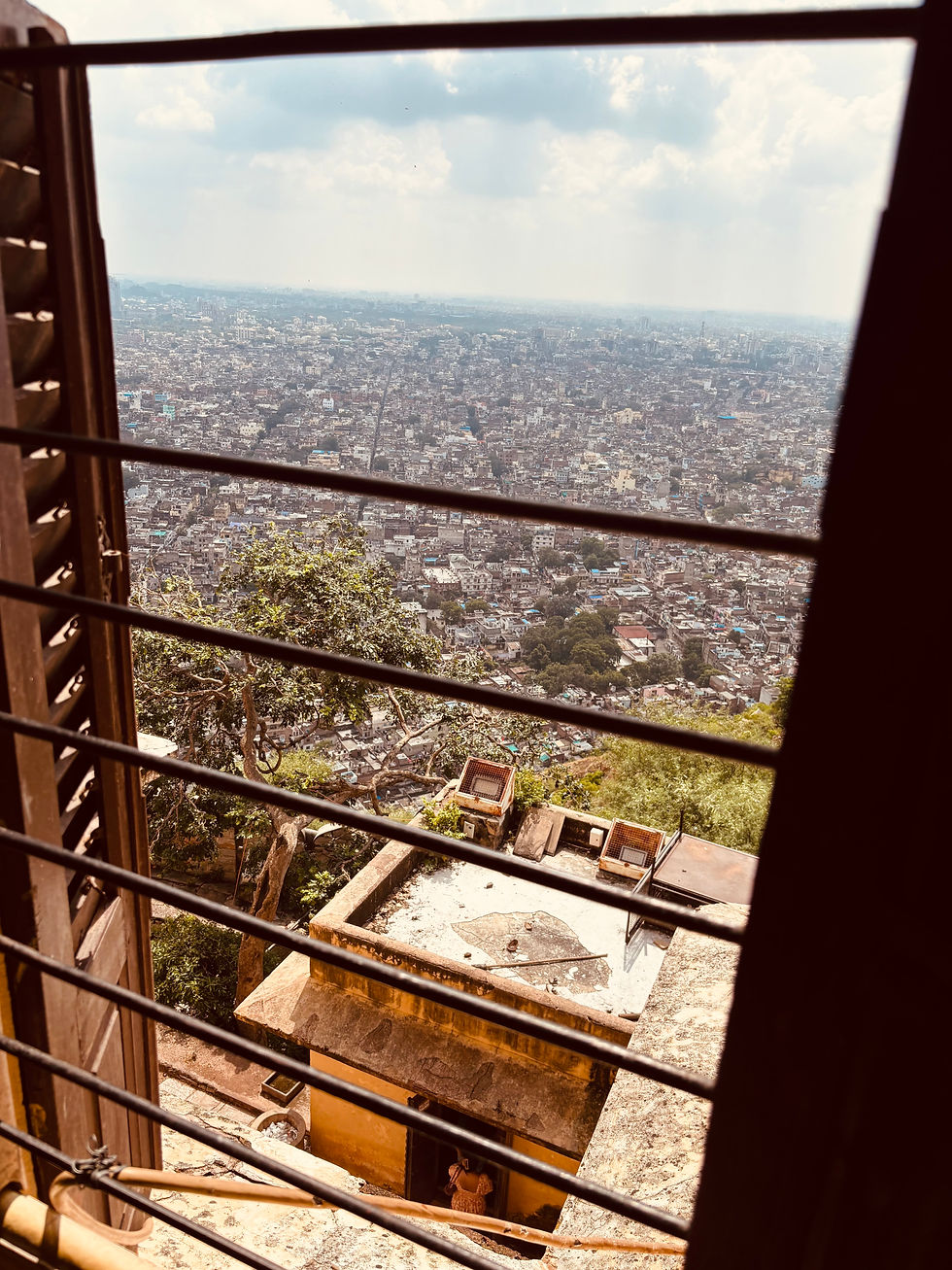
We started our second day with a visit to Nahargarh Fort, perched gracefully atop the Aravalli Hills. As we ascended in our rented car, the fort’s majestic silhouette unfolded against the sky, a reminder of the grandeur of 18th-century Rajasthan. Built in 1734 by Maharaja Sawai Jai Singh II, Nahargarh, literally “abode of tigers”, once served as a summer retreat and a strategic defence alongside Amber and Jaigarh Forts. Its intricate carvings, Indo-European architectural elegance, and serene courtyards tell stories of Rajput kings, their queens, and the legends that linger within these walls. The pure brilliance of miniature paintings in floral designs left me awestruck, and capturing them with my camera was indeed a tough job— such intricate designs, such skill that made those walls speak for themselves. I wanted to carry them all with me. Those small windows that imparted a charismatic view of the city were inexplicable.
Quite a few monkeys were roaming around, all clearly fond of juices. I happened to carry a cold drink, which somehow ended up in the hands of one curious monkey. To my astonishment, it was a brand-new, unopened bottle, and the monkey opened it with elan. From that moment, I couldn’t help but keep my eyes on them, often more than on the majestic fort itself. Thankfully, once we stepped further inside, the fort’s artistry and panoramic views of Jaipur’s cityscape captured our full attention again.
It offers breathtaking vistas and architectural brilliance, making it one of Jaipur’s must-visit attractions.
Jal Mahal:

As we descended the Aravalli hills in the car, we caught glimpses of Jal Mahal, the stunning “Water Palace” nestled in the middle of Man Sagar Lake. Its elegant architecture rising from the serene waters offered a beautiful and peaceful view, making it one of the most picturesque sights in Jaipur.
Jaigarh Fort:

Situated atop the Cheelka Teela, or “Hill of Eagles,” Jaigarh Fort in Jaipur is a stunning testament to Rajput military prowess and architectural brilliance. Built in 1726 by Maharaja Sawai Jai Singh II as a defensive bastion for Amber Fort, its sandstone walls offer mesmerizing panoramic views of the surrounding Aravalli Hills and Jaipur city.
We couldn’t explore the entire fort, as my legs were aching from all the walking earlier, but simply taking in the overall view and soaking up the historic vibes was a delight. Part of the fort was being used for a function, with several cars entering the premises, which made our walk a little cumbersome. Still, the sheer scale and grandeur of Jaigarh Fort left a lasting impression, reminding us why it is one of Jaipur’s most iconic heritage landmarks.
Amer Fort – A Regal Masterpiece of Jaipur’s Golden Era:

Resting on a rugged hill, Amer Fort (Amber Fort) rises in breathtaking hues of pale yellow and pink sandstone, an architectural marvel that seamlessly blends Rajput grandeur with Mughal finesse. A UNESCO World Heritage Site and one of Rajasthan’s most celebrated attractions, Amer Fort is a place where history, artistry, and imagination come alive in the most spectacular way.
Commissioned in 1592 by Maharaja Man Singh I, this magnificent fortress once served as the proud capital of the Kachhwaha Rajputs. Its sprawling structure is divided into four imposing courtyards, each with its own charm: from royal residences to audience halls, lush gardens, and secret passages hidden beneath its stone floors.

A fusion of Hindu (Rajput) and Mughal architecture, the fort is adorned with red sandstone, white marble, intricate frescoes, ornate latticework, and precious stone inlays. Several structures, such as the Diwan-e-Aam, reveal the refined taste and lavish lifestyle of its former rulers. But the crown jewel of Amer Fort is undoubtedly the Sheesh Mahal (Hall of Mirrors)—a glittering wonder where thousands of tiny mirrors refract even a single ray of light into a dazzling spectacle.

Hidden beneath the fort lies a restored network of underground tunnels linking Amer Fort to the mighty Jaigarh Fort, a secret military escape route that still carries echoes of its storied past.

We visited Amer Fort on the third and last day of our Jaipur trip, and it instantly became the most memorable highlight of them all. Even though we started early to avoid the crowds, we were surprised to see people arriving even earlier. If you’re planning a visit, go early; the narrow uphill road can easily lead to traffic jams later in the morning.
As I wandered through the winding pathways and climbed the fort’s steep passages, something inside me shifted. I captured countless videos, yet nothing felt enough. I was entirely transported to another era. I found myself imagining what life must have been like inside those ornate chambers… imagining the princesses and queens gently peeking through the jharokhas and latticed windows, their veils fluttering softly in the breeze.
For a moment, I felt as though I was one of them, walking through history, living a life suspended between duty and dream.
Shopping spree in Jaipur:
We had our own little shopping spree across Jaipur...wandering through hidden nooks, tiny alleys, local stalls, and charming handicraft emporiums. I didn’t really follow the “top places to shop” lists online; instead, I stopped wherever something caught my eye, which made the experience even more delightful.
Still, for travellers who want to explore the city’s most loved shopping hubs, a few iconic names deserve a mention. Johri Bazar, famous for its jewellery and vibrant fabrics; Bapu Bazar, known for colourful jutis, textiles, and souvenirs; and Tripolia Bazar, the go-to place for stunning lacquer bangles and traditional crafts—all remain timeless favourites for tourists.
I must also add that Chokhi Dhani surprised me with its beautiful boutique-style shops offering lovely bangles, bags, earrings, and handcrafted trinkets. It’s definitely worth browsing while you soak in the cultural ambience.
Whether you follow the popular markets or trust your instincts like I did, shopping in Jaipur promises its own kind of magic—colourful, spontaneous, and wonderfully unforgettable.
Local delicacies of Jaipur(Dishes you must try):
Jaipur is a city bursting with flavours, and there are certain local delicacies you simply cannot afford to miss. As you wander through its bustling markets, tiny lanes, small shops, and inviting restaurants, treat yourself to Jaipur’s iconic bites—mirchi vada, pyaaz kachori, and a tall glass of refreshing lassi.
And, of course, no culinary journey in the Pink City is complete without indulging in a traditional Rajasthani thali. This royal spread offers an unforgettable mix of both vegetarian and non-vegetarian specialities: Dal Baati Churma, Gatte ki Sabzi, kadhi, papad, pickles, rotis, along with hearty dishes like laal maas, chicken tikka, and succulent kebabs.
The list of Jaipur’s delights is truly endless, each dish carrying the warmth, spice, and richness of Rajasthan’s culinary heritage.
Book Your Jaipur Monuments & Chokhi Dhani Tickets Online:
To make your Jaipur trip smooth and stress-free, it’s a great idea to book tickets for key attractions in advance, as we did. And believe me, it really helped us save time and energy. Here are some online links you can use:
The government’s official booking site for tourist attractions across the state: https://www.obms-tourist.rajasthan.gov.in/ — Book tickets for Jaipur monuments online.
Chokhi Dhani, Jaipur Village Booking: You can book tickets or reserve your spot: https://chokhidhani.com/booking/ — Official Chokhi Dhani Jaipur booking page for tickets and reservations.
Or use this direct village fair booking link:
https://village.chokhidhani.in/ — Chokhi Dhani Village Jaipur online reservation that lets you choose dining options and package preferences
I must say Jaipur blends heritage, culture, and flavour like no other. A city that dazzles at every turn and promises an experience worth returning to. Do let me know your experience once you visit this mind-blowing place with your family or on a solo trip.
By Nandini Sengupta
@metaphors_of_life


Comments